Building social connections in practice: National training program
Happy Cities led a national workshop series for Canadian planners to develop policy and design tools for social wellbeing in housing, in collaboration with Hey Neighbour Collective and SFU Renewable Cities.
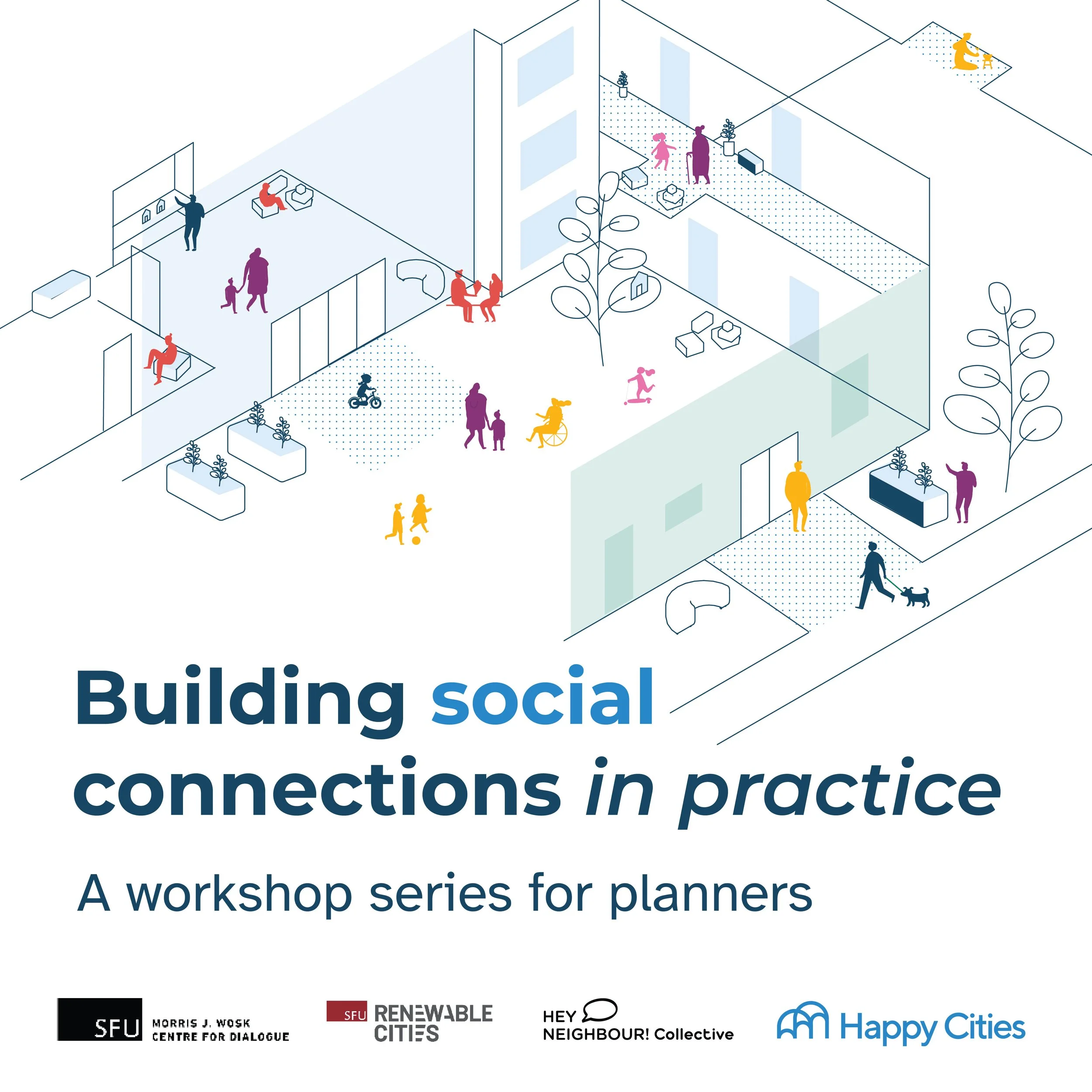
Communities across Canada face growing challenges — climate change, housing affordability, escalating construction costs, loneliness and social isolation, aging populations and more. Housing is a critical tool for tackling many of these problems at once. In particular, the design of our homes influences how likely we are to feel happy, healthy, and connected with neighbours.
The challenge?
Local and municipal policy — often unintentionally — makes it incredibly difficult to design denser housing that supports social connection and wellbeing.
Planners play a crucial role in supporting the development of housing that contributes to more socially connected, resilient, inclusive and age-friendly communities.
In response, Hey Neighbour Collective, Happy Cities and SFU Renewable Cities hosted Building social connections in practice, a national training cohort for planners to gain practical policy and design tools to nurture wellbeing in multi-unit housing in their community.
Motivations for attending
The training cohort brought together 108 planners from 49 local governments in 10 provinces and territories. When asked why they were interested in attending, planners emphasized the importance of discussing challenges with peers while gaining new perspectives.
Here’s what they said:
“We are always on the lookout for policies and initiatives that ensure not only quantity of housing supply, but also its quality in every way [....] It would be especially valuable to gather with these practitioners and many others around the country, working to address the same challenge, in a place of professional discourse and ideas exchange. Thank you for offering this opportunity!”
“I see this workshop as an opportunity to gain a deeper understanding of how social connections can be integrated into design practices. Additionally, I want to gain practical strategies to enhance my interpersonal skills and build more inclusive and supportive networks in both my personal and professional life.”
— Building social connections in practice participants
The workshop experience
Delivered between January and April 2025, this three-part workshop series used a peer learning model to share best practices and policy development challenges. Each 2.5-hour session featured presentations, peer connection and breakout sessions to learn from leading experts.
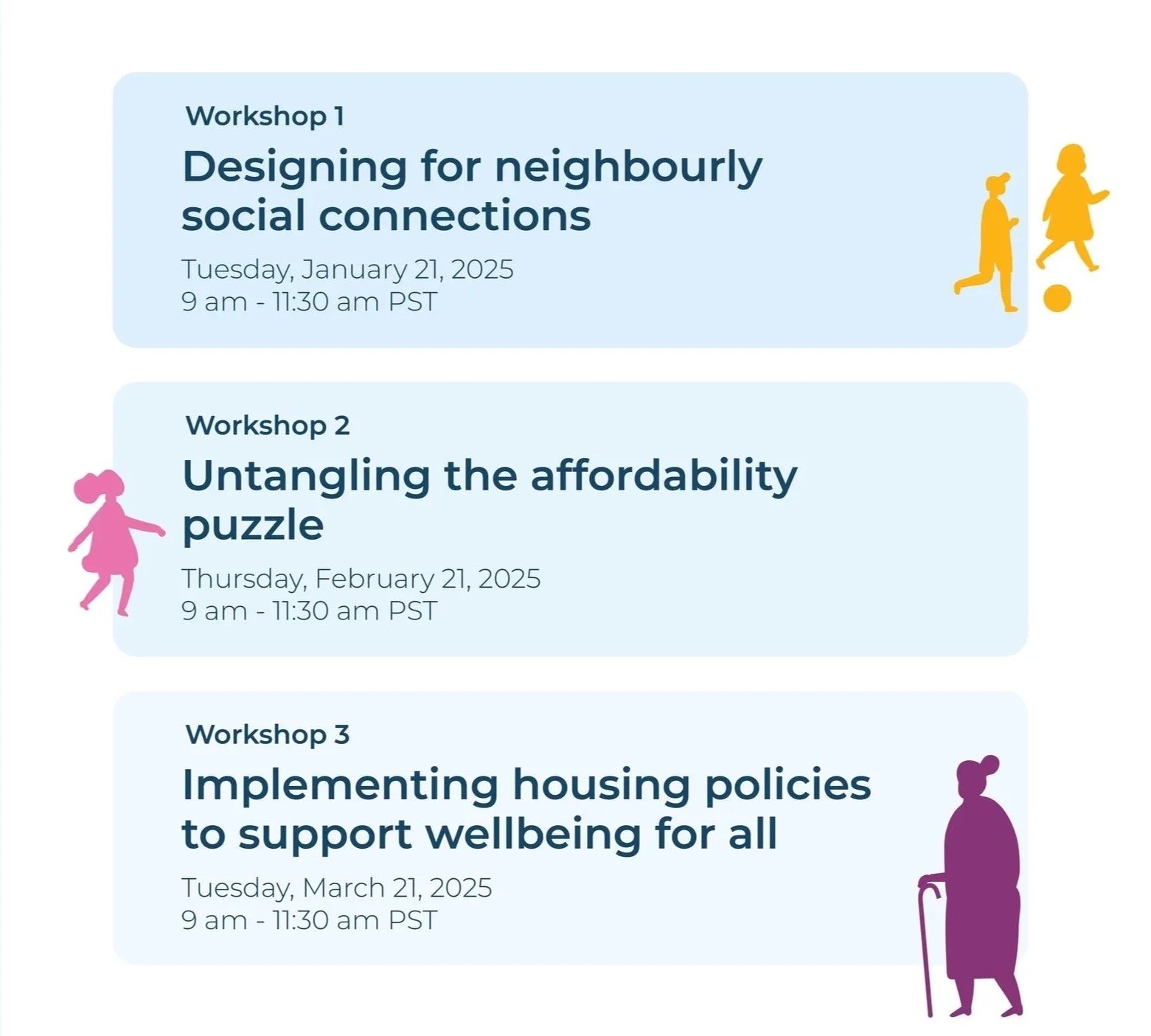
Workshop 1: Designing for neighbourly social connections
The first session of the series shared principles of how building design can affect social wellbeing and connectedness, and the role of policy in supporting these approaches. It also explored existing barriers in participants’ contexts.
Topics covered included:
A deep dive into design for social connection with Happy Cities
Learnings from case studies featuring the Cities of Port Moody and North Vancouver with Madeleine Hebert
Ask an expert about architecture and the built environment, with Bruce Haden from FLUID Architecture, Peter Atkinson and Sarah Klym from Human Studio Architecture, Michael Piper from ReHousing, and Erin K. Peavy from HKS Architects
Workshop 2: Untangling the affordability puzzle
Understanding how housing developments are financed is critical for planners when considering how affordable housing can be developed. The second of the series focused on exploring the factors that affect rental rates, as well as examples of housing projects that integrate social connectedness.
Topics covered included:
Untangling the affordability puzzle with Robert Brown from Chesterman Properties
Vienna House case study with Happy Cities
Ask an expert about housing financing, with Robert Brown from Chesterman Properties, Alicia Medina Laddaga from Sacha Investments, Josh Taylor from Neighbours, Jessica Chen from JIA Foundation and Wabi Sabi Planning Lab, and Ryan McKinley from Vancity
Workshop 3: Designing housing policies that support wellbeing for all
Pulling together learnings from the previous sessions, the final workshop focused on policy directions and levers that planners can use in their contexts. Participants chose two expert-led discussions, exploring policy practices such as partnership developments, missing middle housing, social design guidelines and an action planning group discussing what opportunities are available in their contexts.
Topics covered included:
Learnings about partnerships in building Móytél Lalem with Happy Cities
Considering policy directions for planners with Happy Cities
Learnings from Little Mountain Cohousing with Happy Cities
Ask an expert about policy development, with Michael Piper from ReHousing (missing middle housing), Houssam Elokda from Happy Cities (development in smaller communities), Mary De Paoli from the City of Port Moody (social design guidelines policy), and Steven Collyer from the City of Penticton (partnerships and mid-size city development policies)
What participants gained
When reflecting on the workshop series, participants emphasized the benefit of the conversations and exposure to new ideas:
“A whole new lens on the work I'm involved in, and see around me, in Community Planning as well as many ideas for the strata I live in.”
“My colleagues and I had great discussion throughout and following each portion of the workshop. It was extremely well done and great for facilitating learning! We have a number of ideas to bring back for wider Planning team discussion.”
“Valuable session. Excited to learn more form this group. Leaving inspired.”
— Building social connections in practice participants
What’s next?
In spring 2026, we will be taking local government planners across Metro Vancouver on building tours to showcase their climate resilient and socially connected features. We are continuing to collaborate on policy workshops in the City of Burnaby and New Westminster with a focus on design guidelines for specific building typologies.
Get in touch
Interested in joining or supporting this work? Email mhoar@sfu.ca or madeleine.hebert@happycities.com