
Social infrastructure that matches growth
Measure access in your community and develop a practical, evidence-based roadmap for social infrastructure investment.

How can cities plan for social infrastructure?
Cities spend millions of dollars on new infrastructure each year. But most lack a clear plan of how and where to invest in spaces like public spaces, parks, libraries, and community centres—and how to balance between competing priorities.
We help cities and planners:
Measure social infrastructure access and needs across neighbourhoods
Identify how much social infrastructure your community needs for every 1,000 new residents
Determine the best funding model to align social infrastructure with planned growth
Use an equity-based approach to allocate new infrastructure investments to the communities that need it most
When do you need a social infrastructure strategy?
Without a clear strategy:
New community amenities get decided on a case-by-case basis
Infrastructure provision is inconsistent across neighbourhoods
Decisions are susceptible to changing council priorities and the loudest voices in the room
Residents often feel that investment is distributed unfairly
How a social infrastructure strategy works
-
Assess how effective current social infrastructure is across your jurisdiction and identify clear benchmarks for planned growth:
Assess current access levels in your community by transit, walking/rolling, and biking
Engage community members to understand how social infrastructure is currently working and where it can be improved
Measure social performance and operational capacity of existing infrastructure, such as community facilities, libraries, parks, and more
Develop an interactive online dashboard to make it easy for staff to understand where infrastructure is most needed
Establish evidence-based standards for social infrastructure per capita
Determine how much new infrastructure will be needed according to planned growth
Identify potential funding models
-
Identify and implement the most effective policy tools for social infrastructure planning, such as:
Capital planning criteria to score proposed social infrastructure projects according to community need
Equity-based policy framework to ensure that new infrastructure goes where it is most needed
Social infrastructure action plan or strategy outlining immediate, medium, and long-term needs, with a funding plan of how to get there
-
Following the adoption of policy for social infrastructure, we provide guidance and help assess impact and use over time, such as through
Identifying success metrics to assess the impact of policy
Updating mapping dashboards and datasets
Updating priorities every 1-5 years based on new data and strategic direction
Ongoing community engagement to understand impact

Community engagement for Halifax’s North End Library renovations. (Halifax Regional Municipality)
Case study: Halifax Regional Municipality Equity Priority Framework
A replicable, data-backed methodology to support equity through capital planning
Happy Cities led the development of Halifax’s Equity Priority Framework, working with Licker Geospatial to measure existing access to social infrastructure and help staff prioritize capital investment where is is needed most. Key outcomes:
Use socioeconomic status indicators to identify equity priority areas—communities with low material security and social connectivity, and high social diversity
Interactive online dashboard measuring access to different types of social infrastructure by active travel and transit
Equity criteria for capital planning—a consistent decision-making process and scoring criteria for staff to assess equity impact of proposed projects and inform recommendations to council
Monitoring and evaluation tools to assess long-term impact of the policy
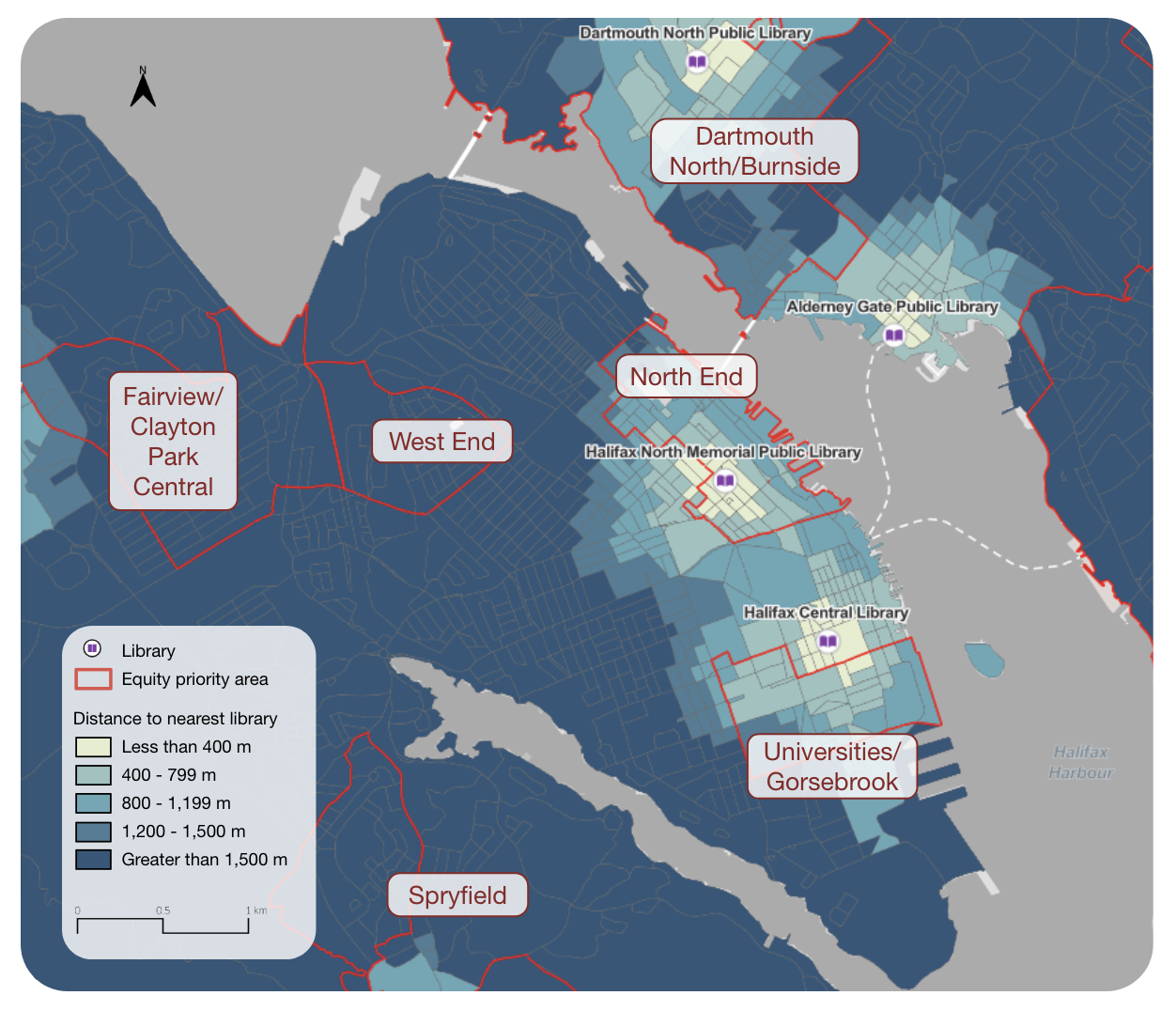
Interactive online dashboard showing infrastructure access in Halifax. (Halifax Regional Municipality)
Related community planning services
-
The design of neighbourhoods and public spaces shapes how likely people are to spend time in the public realm and connect with people while out during daily errands or routines.
We work with municipalities, health authorities, and community associations to develop:
Neighbourhood-scale public space strategies
Community action plans to improve health and connection through the design of the built environment
Dedicated public realm strategies to support inclusion for older adults, youth, and other groups that may have unique considerations
-
We create accessibility plans, policy reviews, and design audits for municipal clients, developers, and more, centering the voices of people with lived experience. Our team includes Rick Hansen Foundation Accessibility Certified professionals.
-
Post-occupancy evaluations include surveys, interviews, walking tours, building audits, and other methods. They combine both qualitative and quantitative data to create a clear picture of how a building or space is working—and for whom.
We offer academically validated and customizeable approaches to help cities and architects:
Measure wellbeing in community facilities, including social connection, belonging, resilience, inclusion, safety, and more
Compare user experiences in new buildings to prior or existing facilities, to understand the design and programming strategies that strengthen social wellbeing
Develop design recommendations for future social infrastructure projects
-
Our award-winning public life studies reveal how people move, feel and behave in public realms. Our innovative experiments generate unique insights and impactful stories. We use these tools to boost wellbeing, equity and place value.
-
We map your existing infrastructure and assess how well it is meeting community needs. Our methods include technical analysis and mapping, alongside deep community engagement to understand how users experience infrastructure and the challenges they may face. Through this work, we offer a practical framework to help your municipality prioritize investments and understand the level of need for different types of social infrastructure.
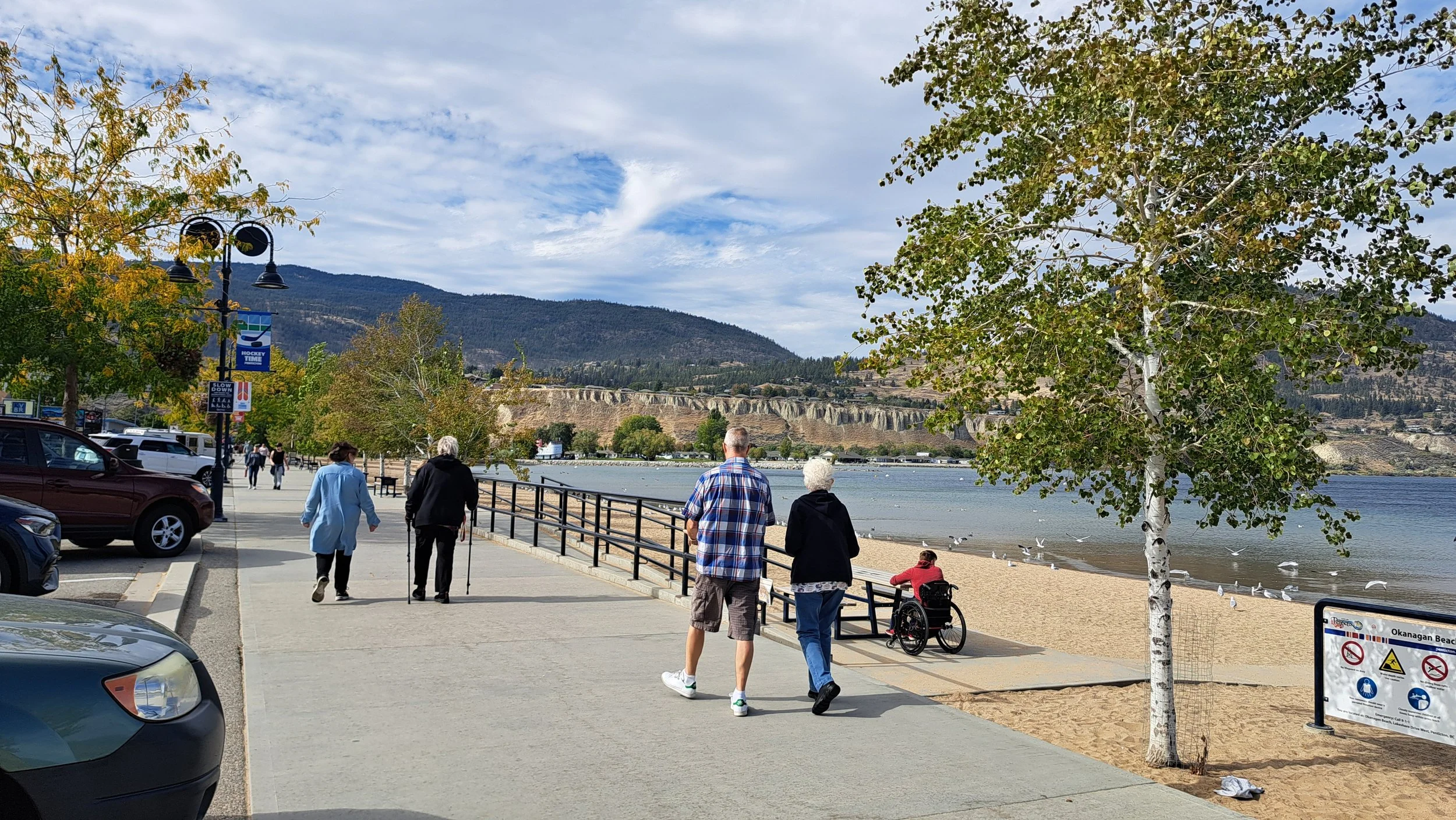
Accessible pathways at one of Penticton’s beaches, reviewed as part of an accessibility audit for the city’s waterfront areas. (Happy Cities)
Explore more social infrastructure projects


