Downtowns and main streets people keep coming back to
Transform a car-centred area into a vibrant, people-centred place—without worsening congestion.

Most network plans don’t address placemaking. Most placemaking plans don’t address network challenges. Yet, these challenges are interlinked.
Happy Cities and Mobycon have developed the “flow and place plan”—an evidence-based planning approach that addresses both challenges together.
When does your community need a flow and place plan?
People visit your downtown to walk around, but mostly still arrive by car
Residents oppose attempts to make destinations and streets more people-centred
The local main street is both a destination and a traffic corridor, causing traffic congestion
Actions to accommodate driver needs have compromised street life
Council is hesitant to invest in streetscape improvements along main streets
Who is the flow and place plan ideal for?
Small- and medium-sized communities
Communities with a rapidly growing main street or downtown
Municipal planners or transportation planners with decision authority
Downtown or main street BIAs and economic development agencies who work closely with their local government
Cities and towns that own public land downtown
How a flow and place plan works
-
Bring key decision-makers and stakeholders together to develop a people-centred vision with three big ideas for your people-centred place. Activities include:
A kickoff meeting with municipal staff to understand pain points or challenges with the existing system or frameworks (parking, mobility, placemaking), and key upcoming opportunities or ongoing developments that could benefit from a fresh approach.
Review existing municipal plans and guidelines (e.g., transportation master plan, area plans, etc.)
Host a workshop for staff (+ potential for elected official participation) that will:
Collaboratively establish the boundaries of your community's first "people-centred area".
Identify high-level approach to flow and place streets around your ‘people-centred area’
Identify three big ideas for people-centred transformation
What you get: A visual concept map of your first people-centred area; a high-level place/flow network around it; plus the three big ideas for people-centred transformation.
-
What does your downtown or main street look like when you accomplish all your goals? What future revenue could you generate when your downtown succeeds in attracting more people to live, work and visit there?
We clarify your upside so we can anchor how much you can afford to invest in your downtown or main street.
-
Design the key land-use and network planning elements for a people-centred plan that meets the needs of drivers. Activities include:
Develop your detailed flow and place street network.
Develop a high-level pedestrian network concept for integrating pedestrian and cycling paths.
Develop a park-once strategy that supports vibrant connections to 'place streets'.
Develop an 'access zones' strategy for managing deliveries, pick-up/drop-off, accessible parking and waste management.
Provide recommendations for aligning land-use and design requirements to match the updated transportation network.
A ‘development incentive’ policy and implementation package to catalyse development in your people-centred area
Provide focused design concepts and visuals for key street segments, specific intersections and public spaces to demonstrate tangible outcomes.
Conduct public and interest-holder engagement to refine your plan
Develop an implementation plan of proposed pilot projects and future project recommendations, along with estimates for timeline and budget for implementation
-
Build a culture of innovation and trial-and-error, using strategic pilot projects to demonstrate success and create permanent change. Activities include:
Scope and design a series of pilots focused on placemaking, traffic calming and flow street improvements.
Prepare detailed concepts for the proposed pilots.
Establish a framework for monitoring and engaging the community on the performance of the pilot projects, including annual evaluation and planning for subsequent years.
Deliver at least 2 rounds of public engagement and data collection (may include public life studies of key public spaces)
Develop a comprehensive plan of future projects
-
Build understanding and capacity across planners, engineers, and relevant departments to deliver people-centred transformations at scale. We offer:
In-person and online workshops to introduce our framework for people-centred places
Ongoing training and support with updates to road and building design guidelines
Concept development for new opportunities that arise (e.g., a new public plaza)
Evaluation tools to assess impact of pilot projects and shape permanent design recommendations
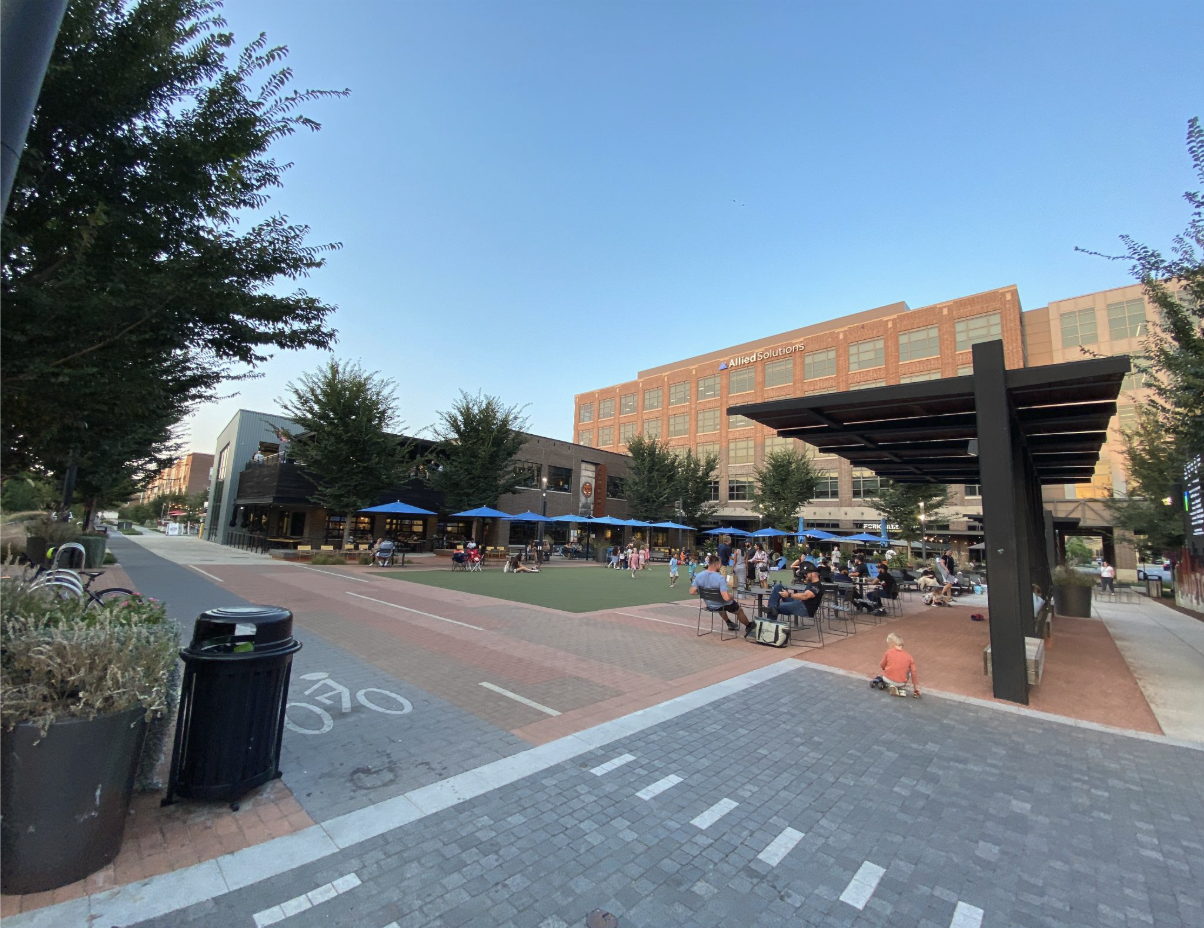
Carmel, Indiana’s vibrant midtown encourages drivers to become pedestrians after they park nearby. (Mobycon)
Resource: People-centred design guide
Four tested strategies to design for drivers in people-centred places
A groundbreaking design guide from Happy Cities and Mobycon offers four strategies to help cities meet the needs of drivers and build places people love, drawing from Dutch mobility expertise and international best practices. We offer practical tools to:
Identify car-centred areas versus people-centred places in your community
Understand the distinct needs of people-centred places, and what can improve driver satisfaction in these areas
Improve travel times without undermining street life
Build driver support for people-centred transformations
Related community planning services
-
From school street murals to international events, we work with cities, BIAs, community groups, and local residents to activate shared spaces and while strengthening community pride and ownership.
-
Main streets are the social and economic heart of any community, but many have suffered through years of disinvestment and car-oriented planning. We work with municipalities to help transform main streets into vibrant destinations, through active transportation recommendations, public realm design, and suburban retrofit strategies.
-
We work with municipalities, BIAs, and community groups to activate downtowns and main streets through strategic placemaking, programming, and policy.
-
Our award-winning public life studies reveal how people move, feel and behave in public realms. Our innovative experiments generate unique insights and impactful stories. We use these tools to boost wellbeing, equity and place value.
-
Successful people-centred places depend on effective transit systems to succeed. We help rural communities optimize the efficiency and convenience of transit networks for riders, generating more foot traffic and customers in town centres and main streets. Then, we help you brand and promote your service to increase awareness and ridership.

Explore more main street projects